
The Dopamine Loop: How Online Casino Mechanics Engineer Anticipation
4 MIN READ
The Dopamine Loop: How Online Casino Mechanics Engineer Anticipation
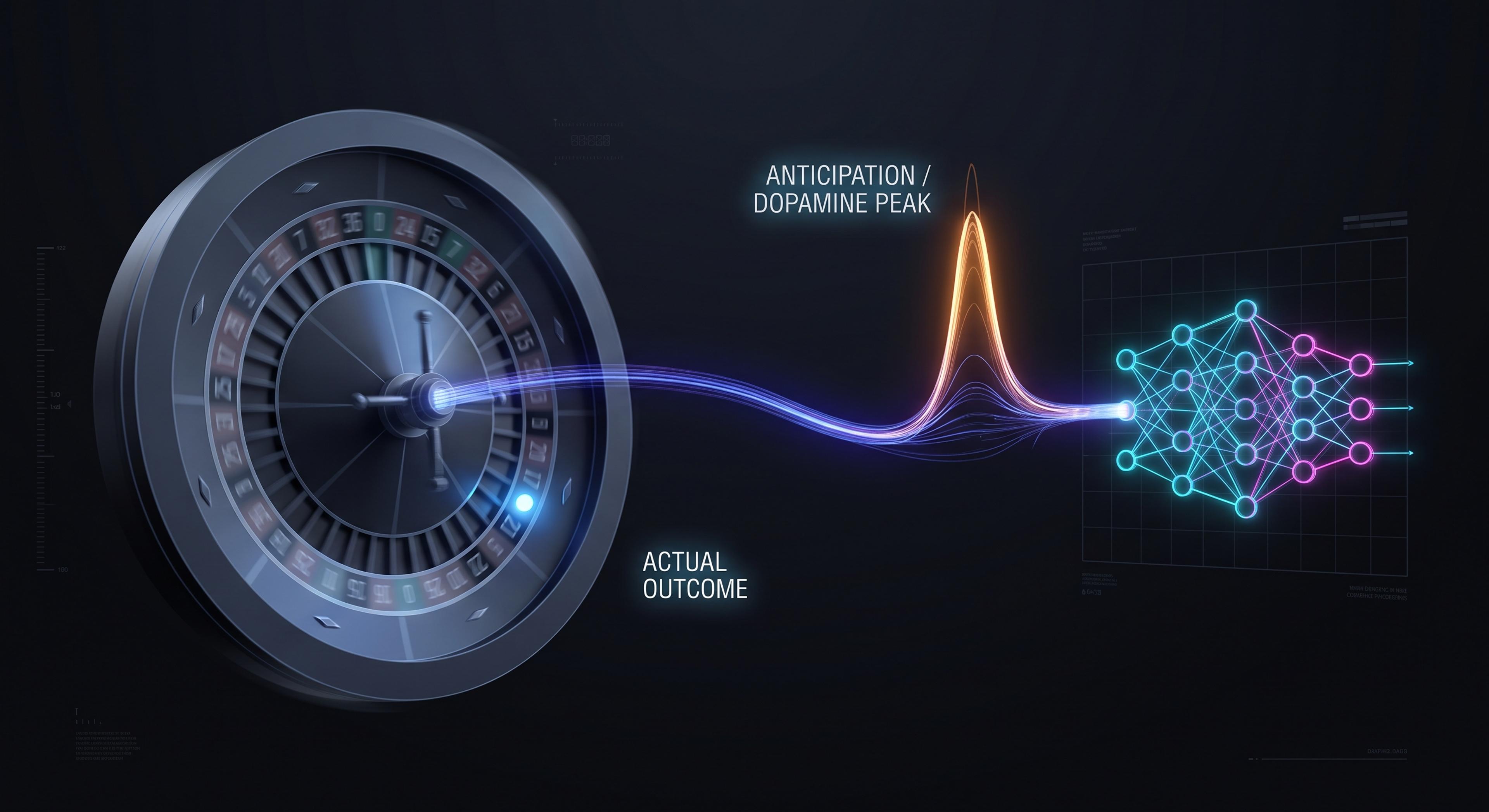
Every time the digital reels spin or a virtual roulette ball bounces across the wheel, a highly calibrated psychological event takes place. It is easy to assume that the thrill of gambling comes entirely from the prospect of winning money. However, clinical psychology and behavioral science reveal a different reality: the human brain is actually wired to reward the anticipation of a reward just as much as the outcome itself.
For players navigating the iGaming landscape, understanding this neurochemical process is the dividing line between strategic bankroll management and emotional loss-chasing. No psychological framework or betting system can dismantle a casino's built-in mathematical advantage—the house edge is an absolute, verifiable statistical reality. The purpose of dissecting these mechanics is harm reduction and strict bankroll preservation, stripping away the illusions engineered by game design.
Advertisement
The Neuroscience of Variable Rewards
At the core of every slot machine and digital table game is a psychological mechanism known as a variable ratio schedule. Established foundational research in behavioral psychology (rooted in B.F. Skinner's operant conditioning studies) demonstrates that unpredictable rewards drive the highest rates of repetitive behavior.
- The Dopamine Spike: Dopamine is a neurotransmitter associated with pleasure, learning, and motivation. Neuroscientific studies on gambling behavior indicate that the most significant dopamine release does not occur when the win is deposited into an account; it spikes during the uncertain moments of anticipation.
- Chasing the Feeling: Because iGaming payouts are unpredictable in both frequency and size, the brain's reward center remains constantly activated. The neurological system continuously scans for the next payout, keeping the player engaged far longer than a predictable, fixed-reward system ever would.
Deconstructing the Illusion of Control
Regulated online casinos utilize highly sophisticated Random Number Generators (RNGs). The exact outcome of a spin or a digital card draw is determined the millisecond a button is pressed. However, the visual presentation—the dramatic audio cues and the slow deceleration of the reels—is specifically engineered to create what cognitive psychologists call the Illusion of Control.
- Interactive Placebos: Features like "stop spin" buttons or the ability to manually "peel" digital cards in live dealer games offer no actual influence over the mathematical probability of the outcome. They exist solely to make the player feel like an active participant in a strictly passive game of chance.
- The "Near-Miss" Effect: Mathematically, landing two out of three jackpot symbols is identical to missing all three. Yet, a near-miss triggers a dopaminergic response nearly identical to an actual win. The brain misinterprets the near-miss as a sign of skill acquisition, creating a false narrative that the player is "getting closer" to a win, which immediately prompts another bet.

Rewiring Your Approach: Clinical Risk Management
Recognizing that game mechanics are actively designed to hijack human neurochemistry allows a player to shift from emotional reacting to analytical strategy. Implementing clinical risk management requires separating mathematical realities from physiological urges.
- Acknowledge the Neurochemical High: When the sudden urge to double a bet after a near-miss strikes, or the impulse to increase stakes to recover a recent loss arises, recognize this as a biological response to dopamine fluctuation, not a rational statistical decision.
- Enforce Hard Boundaries: Deposit limits, strict session time limits, and cool-off periods are not punitive restrictions reserved for problem gamblers; they are essential bankroll management tools for every strategic player. Once a player crosses into an emotional state, adherence to basic math deteriorates rapidly.
- Physical Interruption: Because the dopamine loop is deeply chemical, relying on willpower alone is often insufficient. The most effective countermeasure is physical distance. Closing the application or stepping away from the screen for just fifteen minutes allows neurochemistry to stabilize, breaking the immediate behavioral loop.
Mastering iGaming is not about outsmarting an RNG; it is about mastering one's own cognitive biases. By recognizing the clinical machinery behind the thrill, players can engage with online platforms objectively, treating them as a form of budgeted entertainment rather than an emotional or financial trap.
 Click to claim your bonus now!