When people think about online casinos and sports betting, they rarely consider how cognitive biases in gambling shape our choices. We tend to believe that winning or losing comes down strictly to math or pure luck. However, behavioural science tells a different story. The house doesn’t just rely on mathematics; it relies on how the human brain processes risk.
Understanding cognitive biases in gambling reveals why our minds routinely misjudge odds, and why even experienced players can fall into irrational patterns of thinking.
What Are Cognitive Biases in Gambling?
A cognitive bias is an automatic pattern of thinking that results in distorted perceptions or judgments. In everyday life, our brains use these mental shortcuts to save energy and make quick choices. But when applied to probability, risk, and online gaming, these shortcuts can severely warp how we view the likelihood of winning.
Let’s break down the most powerful cognitive biases that influence how players perceive odds and manage risk.
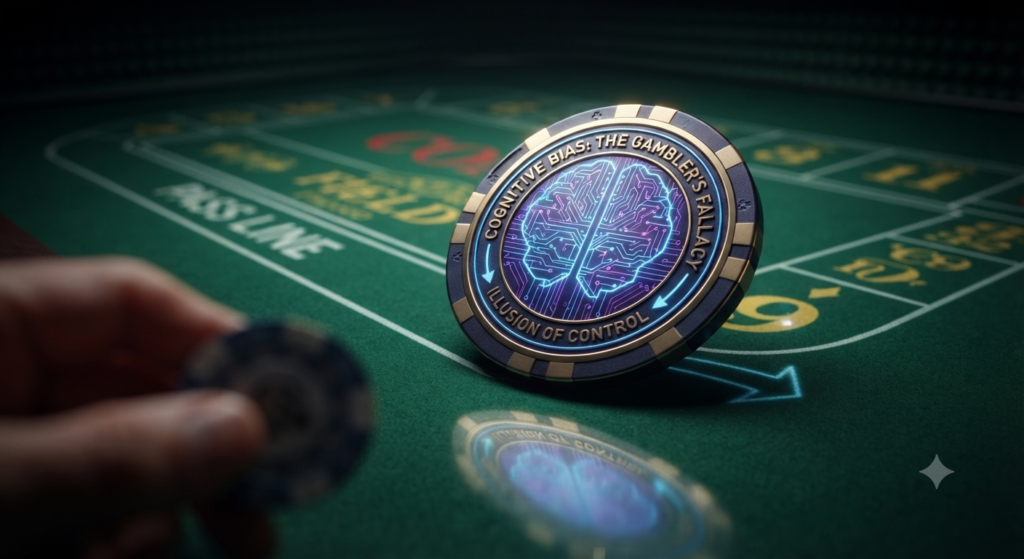
1. The Gambler’s Fallacy
The gambler’s fallacy is the mistaken belief that if a particular event occurs more frequently than normal during a given period, it will happen less frequently in the future, or vice versa.
- How it manifests: Imagine watching a roulette wheel land on black five times in a row. A player experiencing the gambler’s fallacy will heavily convince themselves that red is “due” to hit next.
- The reality: Each spin of a wheel or roll of digital dice is an independent statistical event. Past outcomes have zero influence on future probabilities. The odds reset completely every single time.
2. The Illusion of Control
The illusion of control occurs when players overestimate their ability to influence outcomes that are completely governed by chance.
- How it manifests: In games like slots or automated table games, players might feel that choosing specific “lucky” numbers, pressing buttons with a certain rhythm, or placing bets in a specific ritualistic sequence will alter the payout probability.
- The reality: Modern online casino games use certified Random Number Generators (RNGs). No amount of ritual, timing, or button-mashing can sway the underlying math or lower the house edge.
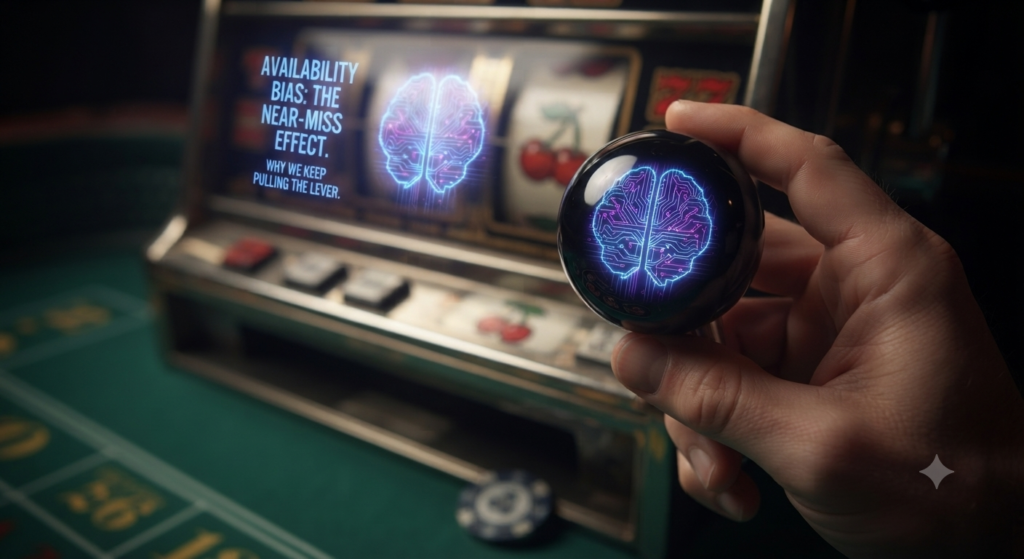
3. The Availability Bias and Near-Miss Effect
Our memories are heavily skewed by what is most emotionally striking. This ties directly into the availability bias and the near-miss effect.
- How it manifests: Players vividly remember the massive jackpot winner featured in promotional banners, while entirely forgetting the dozens of quiet losses that came before it. Similarly, when a slot machine or digital card hand stops just one symbol short of a win, the brain processes it not as a loss, but as a “close call”—tricking the mind into feeling like skill or imminent success is right around the corner.
- The reality: A near-miss is mathematically identical to a complete miss. It offers no statistical indication that a win is closer.
How to Protect Your Mindset While Gaming
Recognizing these psychological traps is the first step toward maintaining complete clarity. Whether you are analyzing sports markets or reviewing online platforms, keeping a grounded mindset helps you treat gaming strictly as form of paid entertainment rather than a predictable income stream.
- Set Strict Boundaries: Define your time and spending limits before you open a gaming session, and never attempt to recover losses on impulse.
- Focus on Transparency: Always look for reputable, fully transparent platforms that provide clear data on odds, rules, and payouts.
- Stay Objective: View every wager through the lens of math and probabilities rather than gut feelings or “streaks.”
Looking to explore transparent platforms with clear, verified user reviews and stats? Check out our top-rated platform breakdowns and guides on Mind the Odds to make informed choices.